
The Business Behind HYROX
HYROX looks like a fitness race, but underneath it is a repeatable sports property monetizing participation, training communities, sponsorships, and the modern gym economy.

There are many fitness trends that sell people a new way to work out.
HYROX is more interesting because it sells people something deeper: a reason to train.
That distinction matters. Because in modern fitness, the workout itself is no longer the only product. People want structure, progress, community, identity, and proof that their effort is actually going somewhere.
HYROX sits directly inside that shift.
At the simplest level, HYROX is a standardized indoor fitness race that combines running and functional workout stations. Participants run 1km, complete one workout station, then repeat that sequence eight times. The official format is: 1km run, functional station, 1km run, functional station, repeated until all eight stations are completed.
The eight workout stations are (If you want to see the details: Source: Redbull)
SkiErg
Sled push
Sled pull
Burpee broad jumps
Rowing
Farmers carry
Sandbag lunges
Wall balls
On paper, the format is easy to understand. But commercially, that simplicity is the point.
HYROX is simple enough to explain in one sentence, but difficult enough to become a serious training goal.
That is a rare balance. If a format is too complex, it becomes hard to scale. If it is too easy, it loses status. HYROX sits in the middle: accessible enough for regular gym-goers to attempt, but hard enough for the finish line to feel earned.
And that is where the business story begins.
HYROX did not need to invent the desire to train. People were already running, lifting, joining functional training classes, tracking their performance, posting their progress, and looking for community.
HYROX did not need to invent the desire to train. It gave that desire a clearer structure.
A target
A scoreboard
A community
A calendar
A reason to come back
Once training becomes measurable, repeatable, social, and aspirational, it starts behaving less like a workout and more like a sport. And once it starts behaving like a sport, the business model becomes much bigger than selling race tickets.
That is the business behind HYROX: not just the event itself, but the system around the event. The simple version:
The race creates the goal
The gym network creates the habit
The leaderboard creates the status
The community creates the retention
The sponsors monetize the attention
The repeat races create the long-term business
That is why HYROX is worth studying. Not only as a fitness trend. But as one of the more interesting modern participation sports businesses today.
1. HYROX is Building the Benchmark for the Gym-Trained Athlete
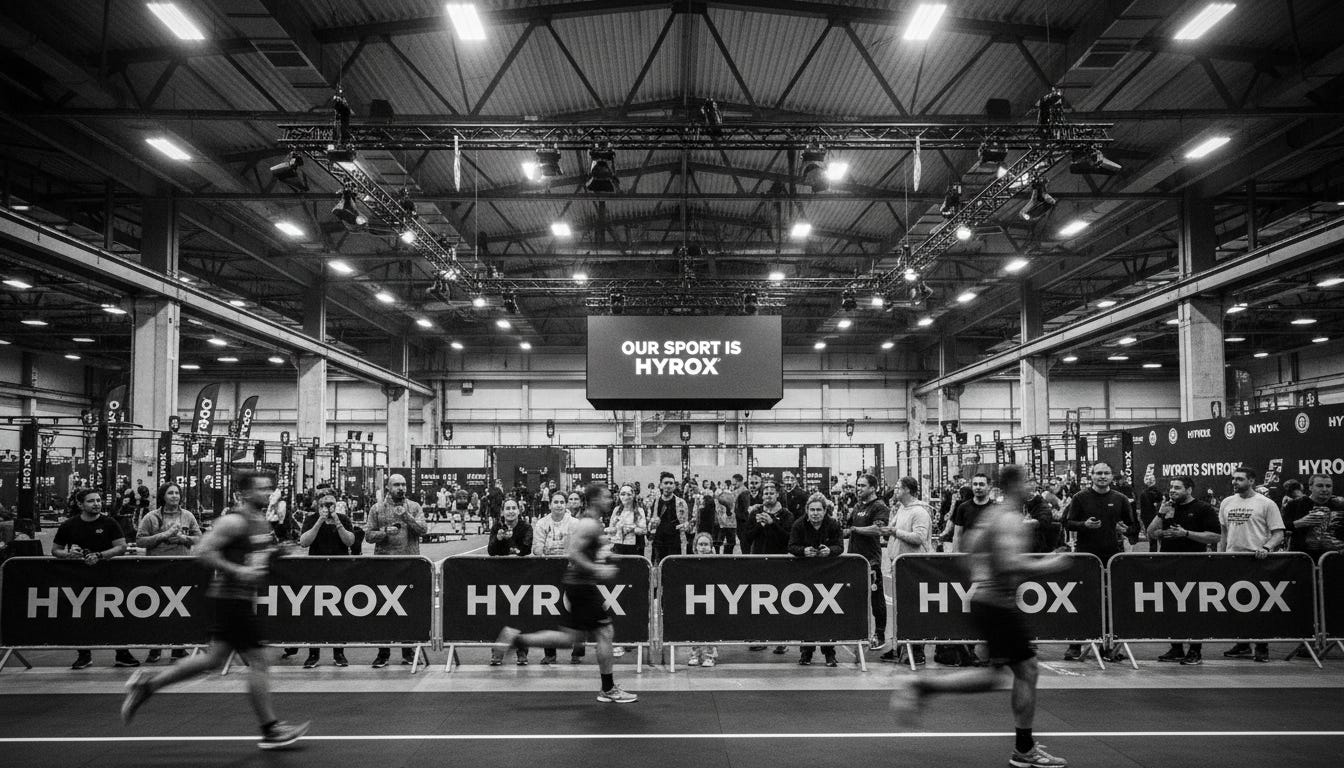
Before discussing the business model, we need to understand what HYROX actually built.
HYROX was founded in 2017 by Christian Toetzke, an industry veteran in cycling, marathon, and triathlon events, and Moritz Fürste, one of Germany’s most successful hockey players and an Olympic gold medalist.
Infront describes HYROX as an event created to bring endurance and functional fitness together in a format that reflected what regular gym-goers were already doing in their workouts.
That founding insight is important.
For years, millions of people were already training inside gyms. They were running, lifting, joining functional training classes, tracking progress, buying performance gear, and looking for ways to feel stronger, fitter, and more capable.
But compared to runners or cyclists, many gym-goers did not have a clear mass-participation benchmark.
Runners have marathons
Cyclists have gran fondos
Obstacle racers have Spartan-style races
Functional fitness needed its own standardized format
HYROX’s real product is not just the workout. It is the benchmark. That benchmark matters because it gives gym training a clearer output.
You do not just join a class. You prepare for a race.
You do not just finish a workout. You get a time.
You do not just say you are getting fitter. You can prove it.
This is where HYROX found its wedge.
It organized existing fitness behavior into something people could train for, pay for, post about, compare, and repeat.
That is a powerful consumer loop.
First race: finish
Second race: improve the time
Third race: bring friends
Fourth race: travel for a bigger event
Long term: make HYROX part of the yearly fitness calendar
The first event creates emotional proof. The second event creates progression. The third event creates identity. And identity is where the business becomes more durable.
Because once someone no longer says, “I tried HYROX,” and starts saying, “I’m training for HYROX,” the product has moved from an event into a lifestyle rhythm.
That is a very different business. The scale also shows how quickly the format has moved. HYROX’s official website says it had
More than 80 global races in 2025
Over 550,000 athletes
Over 350,000 spectators
Campaign Asia also reported that HYROX grew from fewer than 700 participants at its Hamburg debut in 2017 to around 550,000 athletes across 80-plus races in the 2025 season.
That does not mean HYROX has already become a permanent global sport. But it does mean HYROX has found a strong opening inside the modern fitness economy.
The wedge is not just fitness. The wedge is measurable fitness.
And that distinction matters.
2. The Unit Economics of HYROX
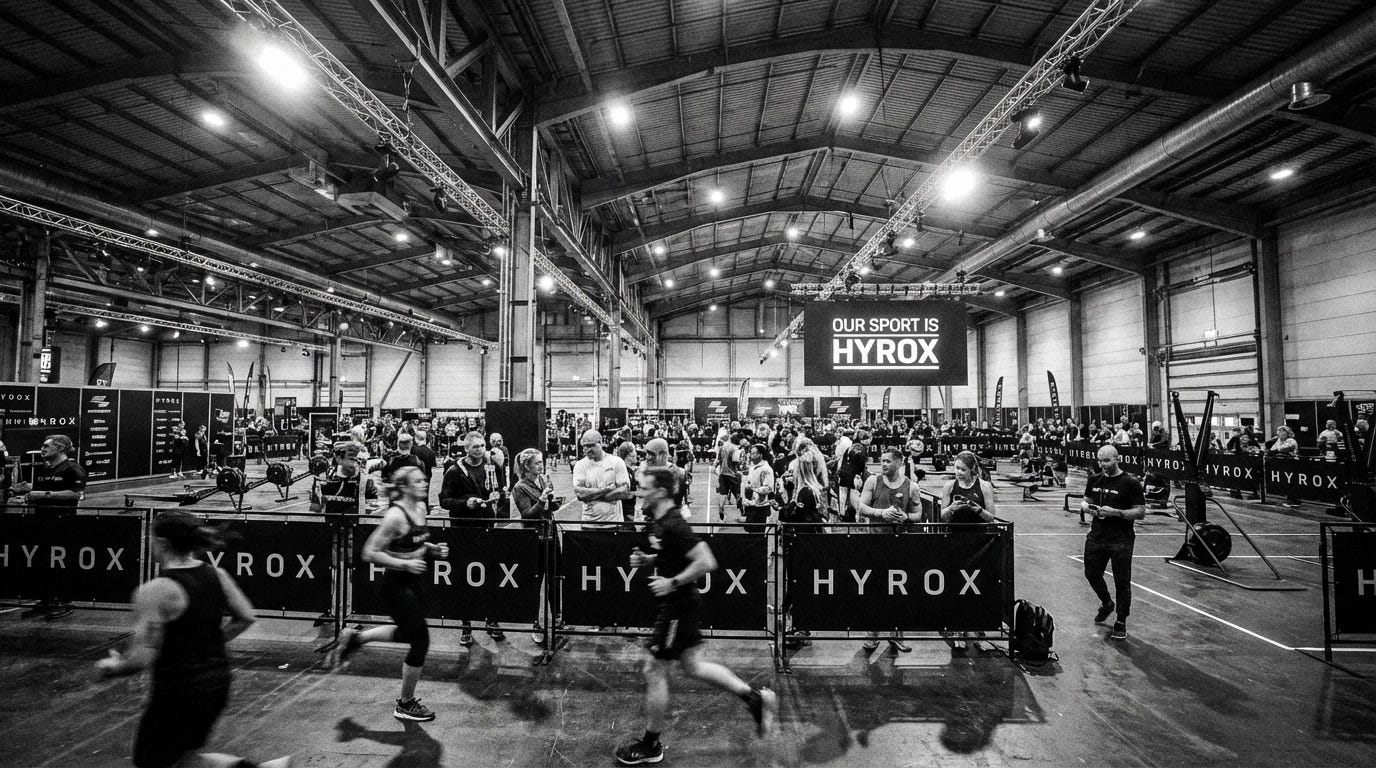
The simple way to understand HYROX is that people pay to race. That is true. But it is not the full story.
The stronger way to understand HYROX is this: HYROX is building a monetization system around modern fitness behavior.
The race is the anchor.
But the business stretches across everything around the race:
Athlete entry fees
Spectator tickets
Brand partnerships and sponsorships
HYROX-branded products / merchandise
Food and beverage sales at events
Gym affiliation fees
Branded programming through affiliated gyms
Race photography and other event add-ons, based on third-party teardown estimates
This is what makes HYROX more interesting than a normal event company.
It is not only monetizing the race day. It is monetizing the preparation before the race, the identity after the race, and the ecosystem around the race.
That distinction matters.
Because if HYROX were only selling one-off event tickets, the business would still be interesting, but much more limited. It would depend heavily on new city expansion, venue capacity, and how many first-time participants it can continue attracting.
But if HYROX becomes embedded into how people train, how gyms program classes, and how fitness communities organize around goals, the business becomes much more durable.
It starts to look less like an event. And more like a sports ecosystem.
A. The race creates the revenue
Race tickets are likely the core revenue engine.
The Times reported that entry fees are HYROX’s biggest revenue stream, making up around 90% of turnover, with additional revenue coming from brand partnerships, HYROX-branded products, food and beverage sales, and gym affiliation fees.
That tells us something important.
B. HYROX today is still highly event led
Every participant is a direct monetization point. The more race slots HYROX can sell across cities, categories, waves, and event days, the stronger the revenue opportunity becomes.
But this is not an easy business to operate. HYROX needs:
Venues
Equipment
Timing systems
Judges
Staff
Safety processes
Ticketing
Athlete flow
Sponsor activation
Local event operations
This is not software. It is physical, operational, and execution-heavy. But the attractive part is that the format is standardized.
Same race structure
Same equipment categories
Same athlete journey
Same leaderboard logic
Same sponsor surface
Same content moments
C. The race creates the content
HYROX is also a very visual product.
The sled push, the wall balls, the finish line, the medal, the exhausted race photo, and the finishing time are not small details around the event. They are part of the product itself. This matters because participation sports are increasingly tied to proof.
People do not only pay to complete a race. They pay for the confirmation that they did something difficult, measurable, and socially recognizable.
That proof becomes content
The content becomes status
The status reinforces demand
In a normal workout, someone might say, “I trained today.”
With HYROX, the story becomes much stronger: “I finished HYROX.”
That sentence carries more weight because it is attached to a recognized format, a finishing time, and a shared cultural reference within the fitness community.
This is where HYROX becomes commercially interesting.
When an event gives people a story they want to tell about themselves, the spending opportunity can extend beyond the ticket.
Race photos become social proof
Merchandise becomes identity
Shoes and gear become preparation
Supplements and recovery become part of the training journey
Future races become the next goal
Not every one of these goes directly into HYROX’s revenue line. But they all expand the consumer wallet around the HYROX ecosystem.
The race becomes more than a one-day event. It becomes the anchor for a larger fitness economy around preparation, participation, proof, and repeat behavior.
D. The sponsors monetize the attention
HYROX also gives brands something valuable: a highly contextual audience.
This matters because the HYROX consumer is not only attending an event. They are training, competing, buying gear, tracking performance, recovering, posting content, and identifying with the fitness lifestyle.
That makes the audience commercially attractive.
HYROX’s sponsorship page describes the platform as a way for brands to reach an active and health-conscious demographic, with touchpoints across physical races, digital channels, gym activations, and affiliate gym partners.
That is important because the audience is not generic. They are already close to categories that want to reach them:
Sportswear
Supplements
Hydration
Recovery
Wearables
Gym equipment
Fitness apps
Wellness products
Travel and hospitality
For sponsors, HYROX is not just selling logo placement. It is selling access to a consumer who is already in the mindset to perform, improve, spend, and share.
That is a very different kind of attention.
Campaign Asia reported that HYROX’s commercial roster includes brands such as Puma, Red Bull, AirAsia, AIA, and Lululemon, reflecting how participation sports partnerships are moving beyond basic visibility into more integrated brand experiences.
This is where HYROX becomes commercially stronger.
The race creates attention
The attention attracts sponsors
The sponsors improve the event experience
The improved experience strengthens the brand
That loop matters. Because in modern participation sports, the sponsor is not only paying for audience size. They are paying for audience context.
HYROX does not just gather attention. It gathers attention from people who are already living the behavior brands want to be associated with.
That is why the sponsorship layer can become more valuable over time. As HYROX grows, the question is not only how many athletes it can attract.
It is also how valuable those athletes are to brands. And for performance, wellness, travel, and lifestyle companies, the answer is likely meaningful.
E. The gym network creates the habit
This may be one of the most important layers of the HYROX business model.
The race creates a moment.
But the gym creates the routine.
HYROX does not only need people to show up on race day. It needs people to keep training, bring friends into the ecosystem, and make HYROX part of their fitness calendar.
This is where the affiliated gym network becomes powerful.
HYROX describes its official Training Clubs as the “backbone of the global HYROX community.” Accredited clubs can use the HYROX brand name and access programming tools, class tutorials, marketing materials, and other coach resources through the HYROX Performance Hub.
HYROX is not only building events. It is trying to embed itself into the weekly rhythm of gyms, coaches, and members.
The loop is simple:
The race gives people a goal
The goal pushes people to train
The training happens inside gyms
The gym community keeps people accountable
The next race gives them another reason to continue
For gyms, HYROX also gives them:
A programming angle
A community-building tool
A member retention driver
A clearer training goal for members
A brand association with a growing global fitness format
That is commercially important because many gyms struggle with consistency and retention. A member with a race on the calendar is usually more motivated than a member casually attending classes.
That is the deeper business insight: the gym is not just a sales channel for HYROX. The gym is the habit engine.
Every affiliated gym becomes a local distribution node.
Every coach becomes an educator.
Every class becomes a soft funnel.
Every participant becomes a potential repeat racer.
The event creates the peak moment. The gym creates the weekly behavior. The weekly behavior creates the long-term business.
3. HYROX Event UE Simulation
Because HYROX is private, we do not have its audited event-level P&L. So this should not be read as HYROX’s actual financial statement.
But we can still use a simple illustrative model to understand why the economics can work.
The Times reported that entry fees are HYROX’s biggest revenue stream, making up around 90% of turnover, with additional revenue from brand partnerships, HYROX-branded products, food and beverage sales at events, and gym affiliation fees.
SBO Financial, A third-party financial teardown also cited a founder estimate that a typical HYROX event needs around 1,500 competitors to break even on a gross basis.
That gives us the logic: HYROX can be profitable when the event is dense enough.
The business is not attractive because events are cheap to run. It is attractive because the format is standardized, the demand can be concentrated into a few event days, and the same operating playbook can be repeated across cities.
A simple event-level simulation could look like this:
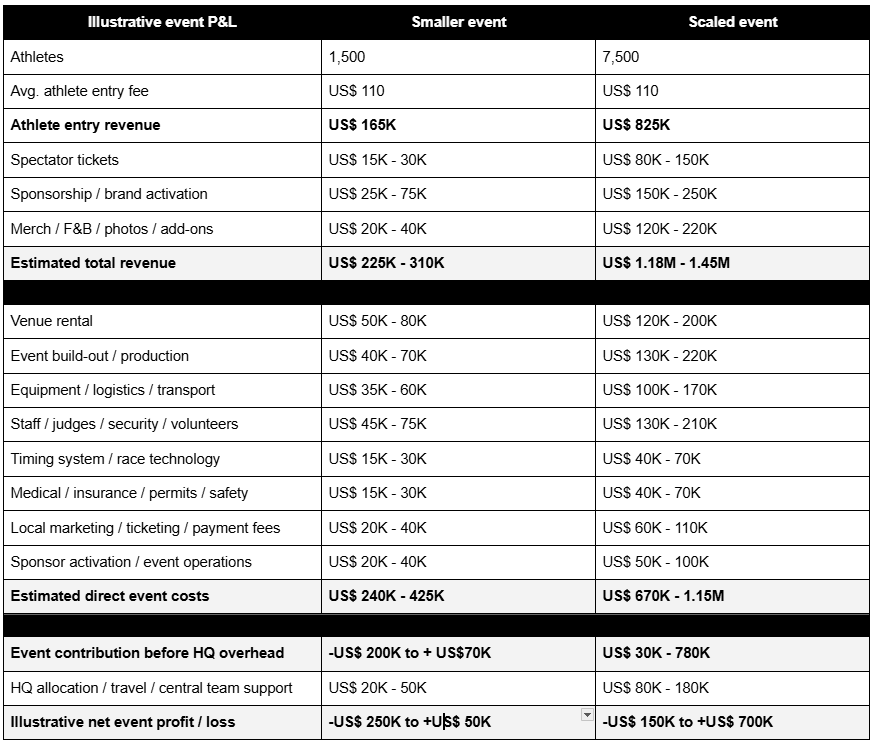
Again, this is not HYROX’s actual P&L. But it shows the basic unit economics logic.
At a smaller event size, profitability can be thin because the event still needs a venue, build-out, staff, judges, equipment, timing systems, safety processes, and local execution.
At a scaled event size, the picture changes. The cost base does not rise perfectly in line with every additional participant. Once the event infrastructure is already in place, incremental athletes, spectators, sponsors, merchandise, food and beverage, photos, and add-ons can improve the margin.
That is the real unit economics logic: fixed event infrastructure first, operating leverage after density.
So the question is not simply: “Can HYROX sell tickets?”
The better question is: Can each city generate enough density to make the event infrastructure profitable?
That is why HYROX’s scale matters. The format creates demand. Event density creates profitability. Repeat participation creates durability.
HYROX becomes financially attractive when popularity turns into density, and density turns fixed event costs into operating leverage.
4. The Real Test: Can HYROX Become a Sport, Not Just a Fitness Trend?
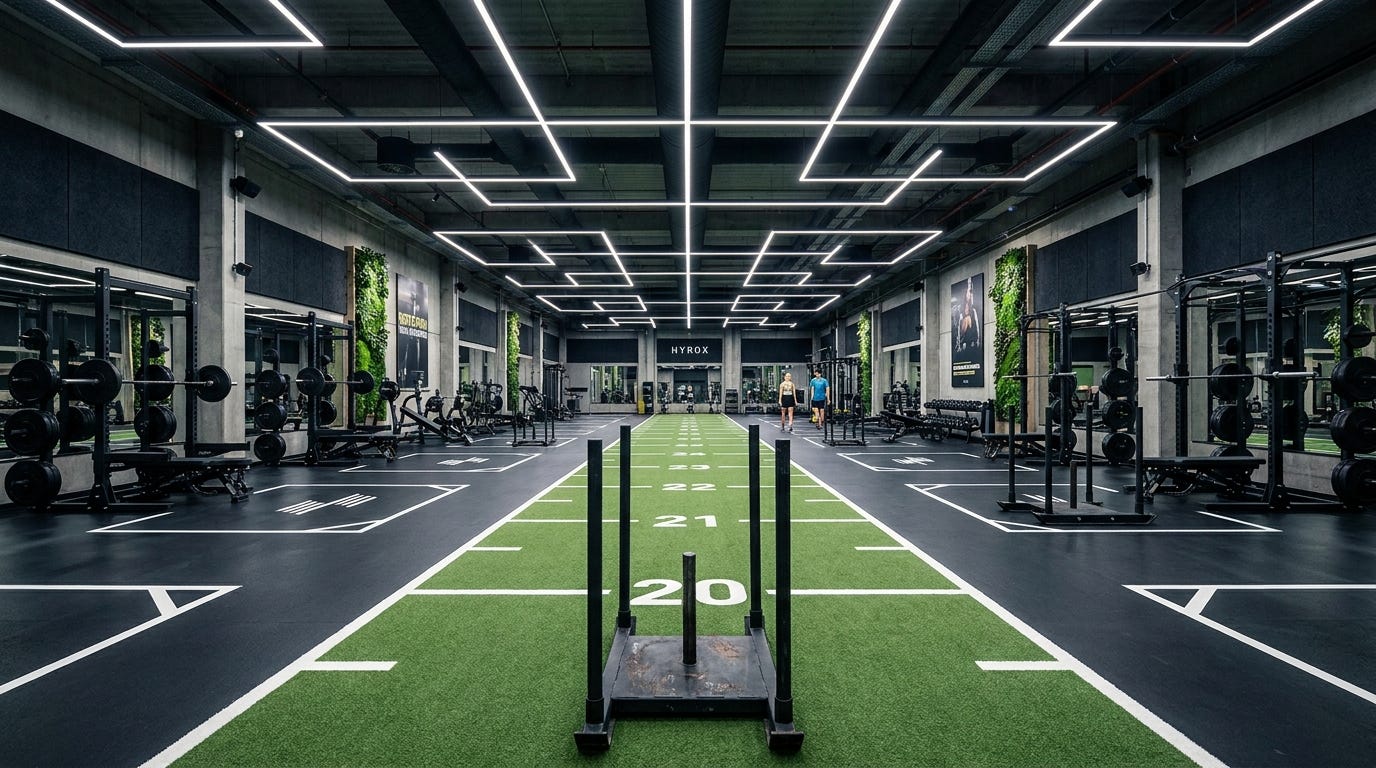
HYROX is clearly having a strong moment. But fast growth alone does not make something durable.
A trend can grow quickly because people are curious.
A sport lasts because people keep coming back.
That is the real test for HYROX: can it move from novelty to ritual?
The first HYROX is easy to understand from a consumer psychology point of view. People want the challenge, the medal, the race photo, the social proof, and the feeling of completing something hard.
But long-term durability depends on what happens after the first race.
Do people come back?
Do they improve their time?
Do they bring friends?
Do they join training clubs?
Do they travel for events?
Do they build their fitness calendar around HYROX?
That is the difference between an event and a sport. A strong event can sell out. A real sport becomes part of people’s routines.
This is where HYROX’s next phase becomes harder.
A. First challenge: consistency at scale
HYROX is selling standardization. That means the experience needs to feel credible across markets.
The format can travel globally, but the experience has to stay consistent locally. That is not easy, because HYROX is not only scaling a brand. It is scaling operations.
Venue quality
Equipment readiness
Judging consistency
Athlete flow
Safety
Crowd management
Sponsor activation
Ticketing
Local community building
All of these details matter. In a physical participation sport, operations are not back office. Operations are the product.
That is why the next phase may be harder than the first one. The early market rewards excitement. The later market rewards consistency.
B. Second challenge: retention
The first HYROX can be emotional.
You train for months
You finish the race
You get the medal
You post the photo
You feel proud
But the real business question is not only how many people try HYROX once. The real business question is: How many people make HYROX part of their identity?
That is where retention matters.
If participants return every year, improve their time, travel for events, bring friends, join training clubs, and build their fitness calendar around HYROX, then the business becomes much more durable.
But if many people only do it once for the experience, the model can still be attractive, but the ceiling becomes different.
A one-time finisher is a customer. A repeat racer is part of the system. And HYROX needs more of the second group if it wants to become a long-lasting sport.
C. Third challenge: accessibility without losing status
HYROX benefits from feeling serious, premium, and hard-earned. That is part of the attraction.
But if the format becomes too expensive, too urban, too competitive, or too dependent on disposable income, it may stay concentrated among affluent fitness consumers.
That can still be a very good business. But it is different from becoming a mass participation sport. For HYROX to keep scaling, it needs to manage both sides:
Enough status to stay aspirational
Enough access to keep growing
Enough difficulty to feel meaningful
Enough inclusivity to bring in new participants
That balance is difficult.
If HYROX becomes too accessible, it may lose status.
If it becomes too exclusive, it may limit the market.
The best participation sports let beginners enter, while still giving serious athletes something to chase. That is the balance HYROX needs to protect.
D. Fourth challenge: defensibility
To be fair, the workout itself is not impossible to copy. Running plus functional stations is not deeply proprietary. So the moat is not only the race format.
The moat is the full system:
Brand
Leaderboard
Event quality
Race credibility
Gym network
Community
Sponsor ecosystem
Athlete identity
Global standardization
HYROX’s defensibility will not come from owning the exercises. It will come from owning the meaning of the official race.
That is a stronger moat than just “we created a workout.”
But it still needs to be defended.
If local gyms, event organizers, or global fitness brands create cheaper alternatives, HYROX needs to prove that the official experience is worth paying for.
E. Fifth challenge: can HYROX evolve beyond the original race?
The current HYROX format is very clear: 1km run, one workout station, repeated eight times. That clarity is one of the reasons it works. The official rulebook defines HYROX around a 1km run followed by one station, repeated until athletes complete 8km of running and 8 workout stations.
But over time, this also creates a new question. Can HYROX keep growing if the core product always stays exactly the same?
Today, HYROX already has multiple race divisions, including Singles, Doubles, Relay, Open, Pro, and age-group categories. That gives the brand different entry points for different athletes:
First-timers who want to finish
Competitive amateurs who want to improve
Teams who want a shared challenge
Elite athletes who need a serious competitive pathway
That is a good start.
But if HYROX wants to become more than a fast-growing participation race, it may eventually need to build more formats under the same umbrella. Not random formats. Ownable formats. That could mean:
Shorter beginner-friendly formats
Club-versus-club competitions
Youth or junior categories
Team-based leagues
Country-based championships
Elite-only formats that are more media-friendly
This is where HYROX needs to be careful.
HYROX’s advantage is simplicity. If the brand becomes too complex, it risks losing the clarity that made the original race powerful.
The Olympic ambition makes this even more interesting. If HYROX wants to move closer to Olympic-level legitimacy, it will need more than participation scale. It will need deeper sport infrastructure:
Clear global rules
Consistent judging standards
Athlete development pathways
Recognized technical standards
Fairness and anti-cheating systems
More watchable elite competition formats
Many HYROX movements already existed before HYROX. Running, rowing, sled push, farmer’s carry, lunges, and wall balls are not new.
So the originality cannot only come from the movements. It has to come from the race architecture, the standards, the scoring, the judging, the athlete pathway, and the cultural meaning of the official HYROX race.
HYROX does not need every movement to be original. But the overall sport needs to feel unmistakably theirs.
That is the next creative challenge.
If HYROX stays too narrow, it may remain a strong participation race. But if it expands too loosely, it may dilute the product.
The best version of HYROX’s future is disciplined expansion: keep the iconic HYROX race as the global benchmark, then build a wider functional competition universe around it.
5. Our View: HYROX Can Last If It Becomes a System, Not Just a Race

Our view is that HYROX is interesting because it gives modern fitness a clearer purpose.
Many people already run, lift, join classes, track progress, and share their fitness journey. HYROX brings those behaviors into one simple format: a race, a goal, a score, and a community.
That is powerful because people do not only want to work out.
They want to feel progress
They want to feel part of something
They want proof that the hard work meant something
HYROX gives them that. It turns training into a story people can follow, share, and repeat. That is why the model feels stronger than a normal fitness trend.
The first race gives people a challenge
The next race gives them a reason to improve
The community gives them a reason to stay close
But the real test is time.
HYROX can sell out races today. The bigger question is whether people will still organize part of their fitness life around HYROX five or ten years from now.
Because a trend gets tried. A sport gets repeated.
And if HYROX can keep people training, competing, improving, and coming back, it has a real chance to become the global benchmark for the modern gym economy.
Thanks for reading all the way through.
If you enjoyed this breakdown, follow Neverlater for more operator-led perspectives on consumer brands, retail, fitness, F&B, and business models across Indonesia and Southeast Asia.
We write about the companies, categories, and consumer shifts worth paying attention to, from the lens of builders, operators, and investors.
For more deep dives, subscribe to our Substack and follow us on Instagram:
Substack: https://neverlater.substack.com/
Instagram: @neverlaterventures
See you in the next one.