
Behind the Conviction #03 - Conversation with Raynald Rabindra Soeharto - CMO at JumpStart
On automated retail, vending machines, consumer convenience, and building a new distribution layer in Indonesia.

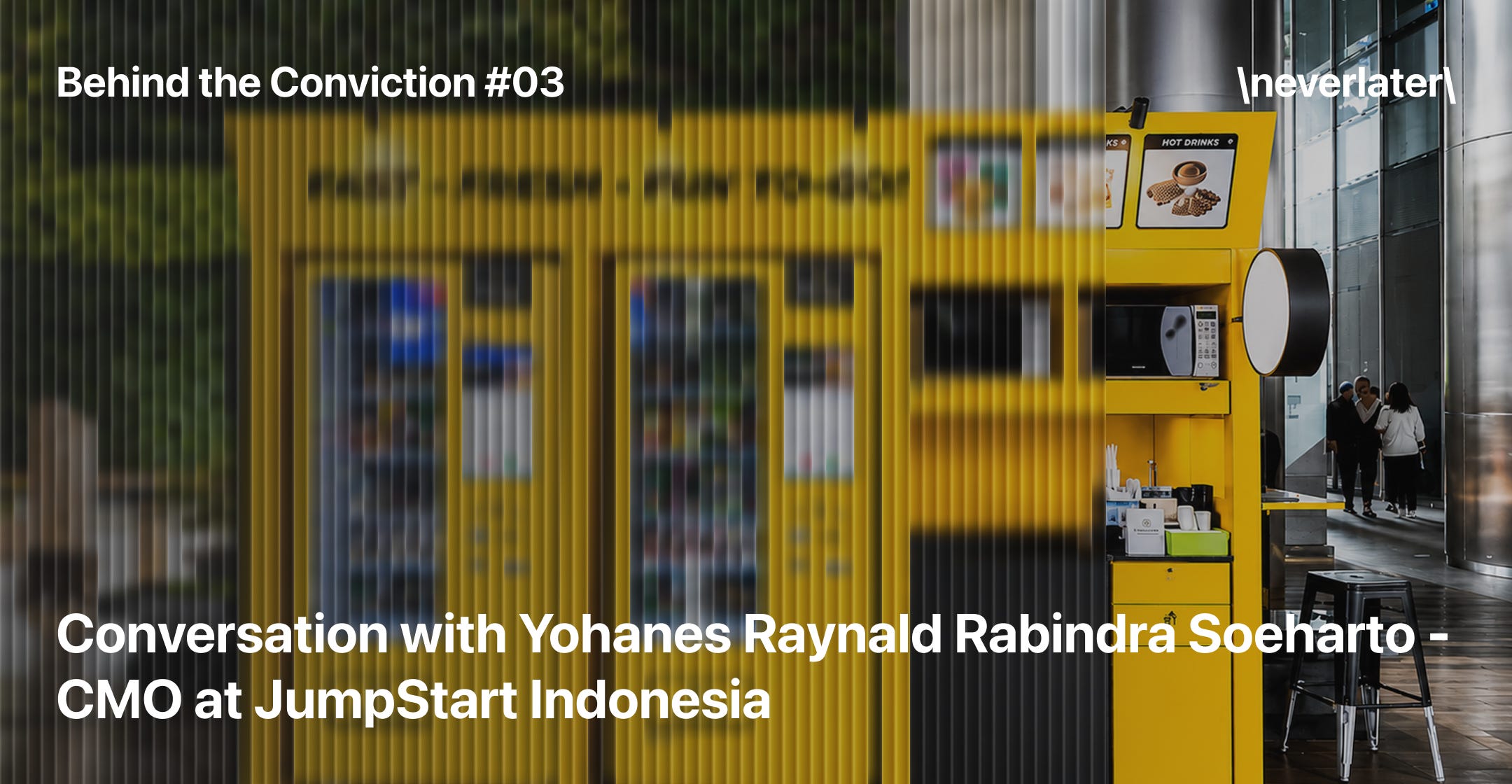
Behind the Conviction is a series where we sit down with founders, operators, investors, and builders to unpack how they think, not just what they do.
For this edition, we spoke with Raynald Rabindra Soeharto, CMO at JumpStart.
At first glance, JumpStart may look simple: put vending machines in good locations, sell coffee, drinks, snacks, or other products, and make the buying experience faster.
But the deeper question is more interesting: Can automated retail become a real distribution channel in Indonesia?
Indonesia already has warung, minimarkets, supermarkets, malls, coffee shops, delivery platforms, social commerce, and quick commerce.
So for vending machines to matter, they cannot just become another place to buy things. They need to solve something specific: speed, availability, location, lower operating cost, brand activation, product discovery, data, or a new way for brands to reach consumers at the right moment.
That is what makes JumpStart interesting to us. It is not only about vending machines. It is about whether automated retail can become a new layer of consumer distribution in Indonesia.
1. Opening Question
Indonesia already has one of the strongest retail distribution ecosystems in Southeast Asia, from warung and minimarkets to supermarkets, malls, delivery apps, and coffee chains. So the tough question is:
Why should vending machines become a real consumer channel here, and not just a novelty format in offices, malls, or public spaces?
That is a fair question, and one we ask ourselves all the time.
Indonesia already has a very strong retail ecosystem. Warungs are deeply embedded in communities. Minimarkets are everywhere. Delivery apps offer convenience. Modern retail continues to expand.
So if vending machines simply replicate what those channels already do, they will remain a novelty.
But we do not see vending machines as competing with retail. We see them as filling gaps that traditional retail cannot always serve efficiently.
The first gap is time. Consumers expect instant access. Traditional stores have operating hours, staffing constraints, and queues. Vending machines can operate 24/7 and serve customers quickly in places like MRT stations, airports, hospitals, universities, office towers, and residential complexes.
The second gap is space and economics. Opening even a small retail outlet requires rent, manpower, fit-out costs, and inventory management. Smart vending allows brands to enter strategic locations with a smaller footprint and lower operating cost.
The third gap is data. A traditional shelf tells you what was sold. A smart vending machine can show what people bought, when they purchased, which promotions converted, and how each location behaves.
So the future is not vending versus retail. It is vending as part of an omnichannel retail ecosystem.
If we only see vending machines as “machines that sell snacks,” they remain a novelty. But if we see them as micro-stores powered by data at the point of demand, they become a much more interesting consumer channel.
2. What JumpStart Is Building Today
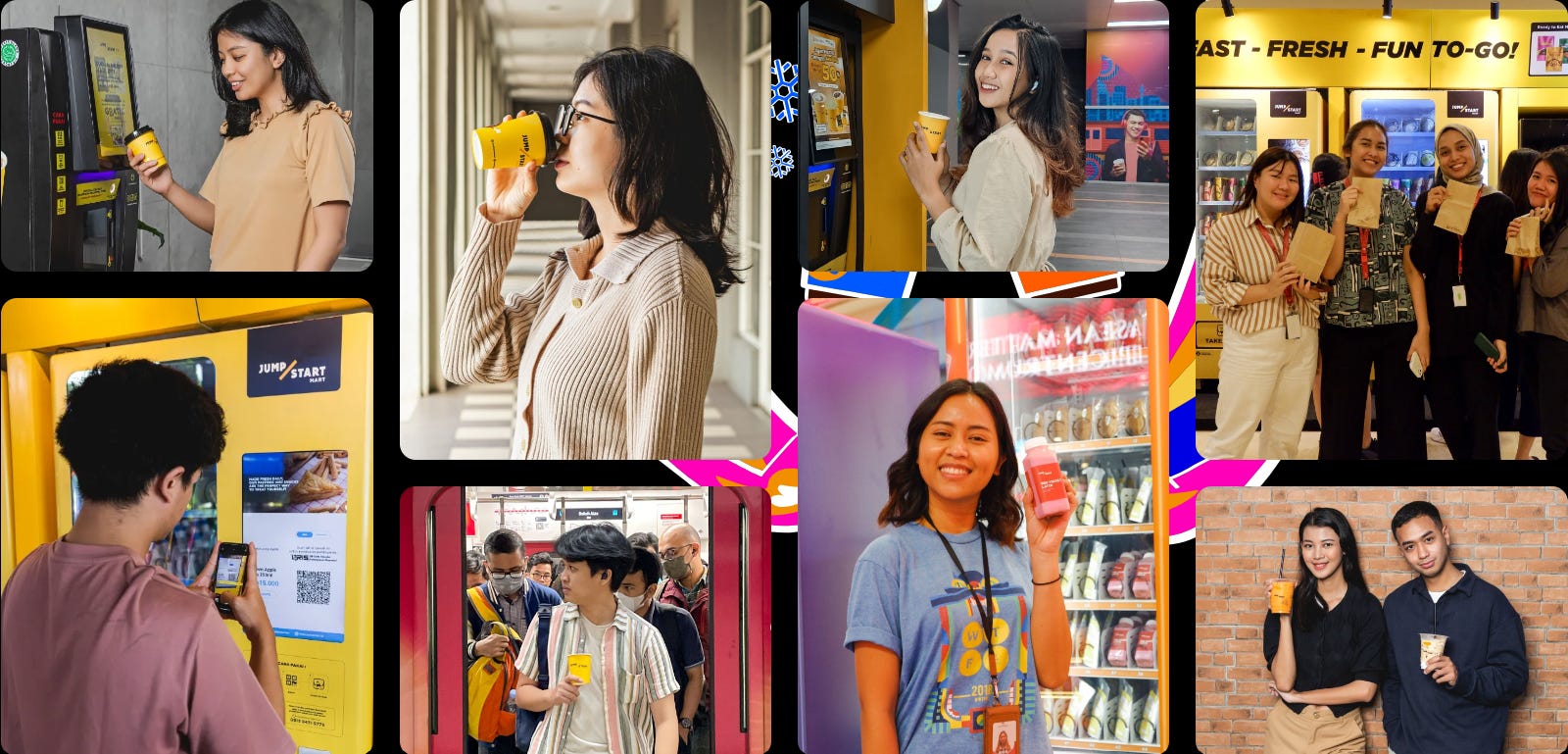
For many people, vending machines are still associated with snacks, drinks, or coffee in a machine.
But JumpStart seems to be building something broader: smart coffee machines, vending machines, smart retail formats, product distribution, brand partnerships, and data-driven retail.
A. For people who are still new to JumpStart, how would you describe the company today?
Is JumpStart a vending machine operator, a smart coffee business, an automated retail platform, a distribution network, or something else?
If you asked me a few years ago, I might have said, “We are a vending machine company.” Today, that answer would be incomplete.
At its core, JumpStart is an automated retail platform. Yes, we operate vending machines. Yes, we develop smart coffee solutions. But those are the products people can see.
What we are really building is the infrastructure that allows brands to sell, distribute, and engage with consumers through unattended, technology-enabled retail experiences.
We sit at the intersection of retail, technology, distribution, and consumer experience.
For consumers, we provide convenience: quality products available instantly, anytime and anywhere.
For brands, we provide access: new channels to reach consumers in high-intent environments without opening physical stores.
For property owners, we help activate underutilized spaces and turn them into revenue-generating touchpoints.
For partners, we provide something increasingly valuable: data.
We can understand purchasing behavior by location, time of day, category preference, promotion effectiveness, and consumer trends in ways that traditional offline retail often struggles to capture in real time.
What excites me most is that we are helping redefine what a store can be.
A store no longer has to be 100 square meters with cashiers and shelves. It can be a smart coffee machine in an office, a beauty vending machine in an airport, a merchandise activation at a concert, a grab-and-go solution in a residential tower, or a customized retail experience inside an MRT station.
The format changes, but the mission stays the same: Bringing products closer to consumers at the exact moment and place they need them.
So if I had to describe JumpStart in one sentence:
JumpStart is a technology-enabled automated retail platform that helps brands scale distribution and create modern consumer experiences through smart, unattended retail.
The machines are important, but they are not the whole business. They are the interface. The real business is the ecosystem behind them: brands, locations, technology, operations, and data working together in a smarter way of doing retail.
B. Looking back to the early days, what was the original problem you wanted to solve?
The original problem was not the lack of vending machines in Indonesia. It was the gap between changing consumer expectations and traditional retail limitations.
Consumers increasingly wanted products that were available instantly, conveniently, and closer to where they live, work, and commute. That was the problem we wanted to solve.
C. JumpStart started from smart coffee vending machines, but has expanded into broader automated retail. What changed in your thinking along the way?
When we started with smart coffee machines, we thought we were solving a beverage problem: how to deliver barista-quality drinks conveniently through technology.
But the turning point came during COVID-19.
The pandemic accelerated contactless and self-service experiences. Consumers became more conscious about safety and convenience, while businesses had to rethink retail models that relied heavily on manpower and fixed store formats.
We realized that the capabilities we had built for coffee, strategic locations, smart technology, cashless payments, remote operations, and real-time data could solve much bigger challenges beyond beverages.
That shifted our thinking from “How do we sell more coffee?”
To: “How do we reinvent how products are distributed and experienced in the physical world?”
Coffee remains part of our DNA, but automated retail became the larger opportunity.
D. If you had to simplify the JumpStart thesis into one sentence, what would it be?
Retail should happen wherever consumers are, not just where traditional stores can exist. Our role is to help brands bring the right products to consumers in a smarter, faster, and more convenient way through automated retail.
3. The Original Idea: Why Vending Machines?
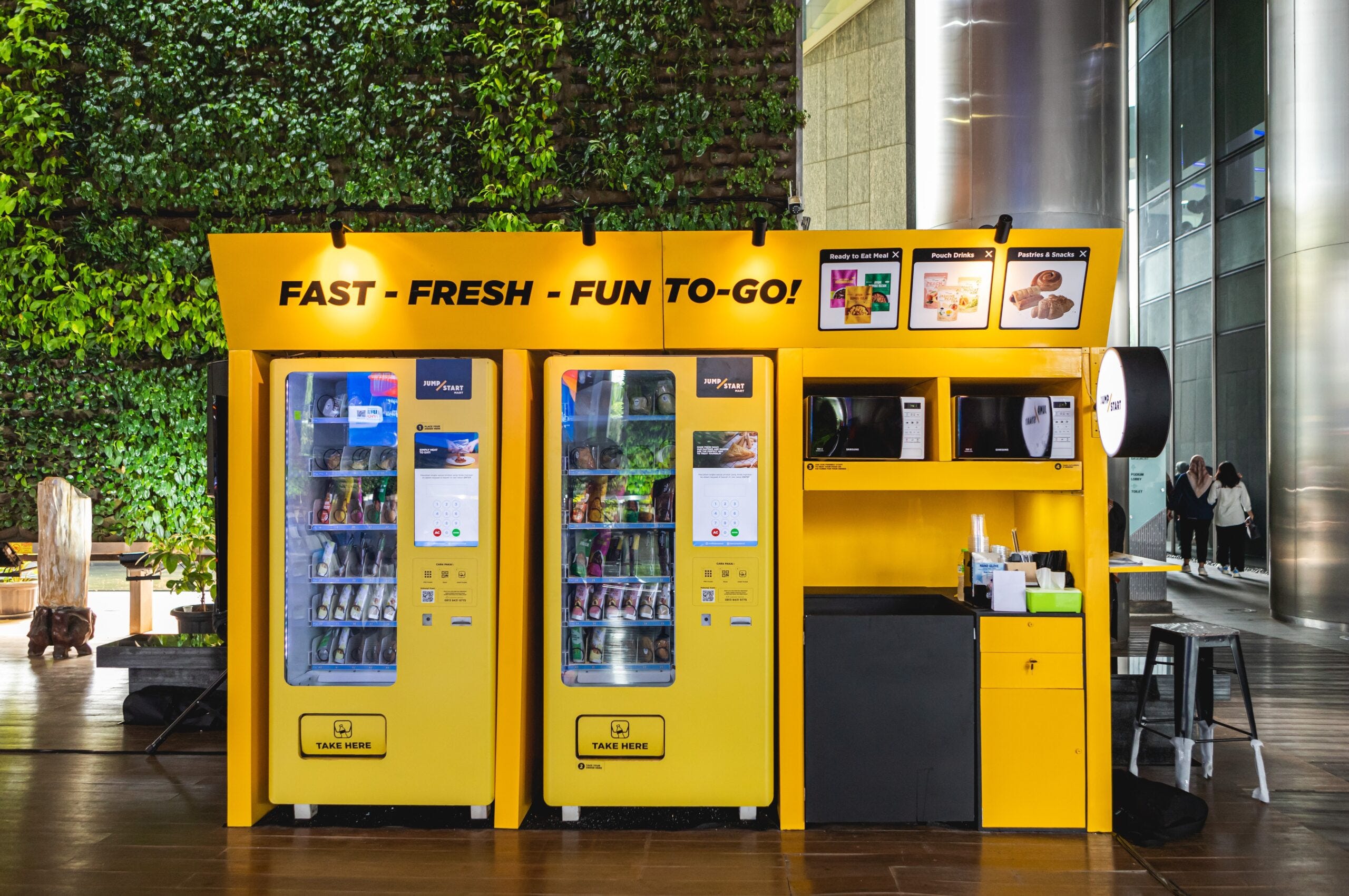
From the outside, vending machines can look straightforward. But in Indonesia, the reality is more complicated. Consumer behavior, location, payment habits, trust, maintenance, product fit, and replenishment all matter.
And the machine itself is only one part of the business. The harder part is building the operating system behind it.
A. What first made you believe that vending machines could work in Indonesia?
Was the inspiration more from Japan, developed markets, local consumer pain points, or your own experience seeing gaps in Indonesia?
The easy answer would be to say, “We were inspired by Japan.” Japan showed the world what vending machines could become when convenience, trust, and technology come together.
But our conviction came more from observing local consumer behavior in Indonesia.
Indonesians are very adaptable when a solution genuinely makes life easier. People embraced ride-hailing, food delivery, QRIS payments, and self-service technologies because they solved real problems.
At the same time, we saw many moments where consumer demand existed, but traditional retail could not serve it efficiently: office buildings, transportation hubs, hospitals, residential areas, and events.
So while developed markets gave us proof that the model could work, Indonesia gave us the reason why it should work.
We were not trying to copy Japan. We were solving Indonesian pain points using a format that had already been validated elsewhere.
Indonesians do not adopt technology simply because it is new. They adopt it because it is convenient, accessible, and improves their daily lives.
B. In the beginning, did you see vending machines more as a consumer convenience play, a coffee innovation, a location-based retail model, or a new distribution channel?
In the beginning, we saw it primarily as a new distribution channel. Coffee happened to be the product, but the bigger idea was always about access.
We believed there were many locations with strong consumer demand that traditional retail could not serve efficiently because of space, operating hours, or cost constraints.
Vending machines gave us a way to bring products directly to where people already were. Over time, we realized this was not just about distributing coffee. It was about creating a smarter, location-based retail model that combines convenience, technology, and data.
At its core, our belief from day one was simple: If consumers are there, brands should be able to reach them in a more efficient way.
C. What were the earliest assumptions you had about Indonesian consumers, and which ones turned out to be right or wrong?
One of our biggest misconceptions was assuming Indonesian consumers would hesitate to use vending machines because they prefer human interaction.
We often heard, “Indonesia isn’t Japan,” or “People here want to talk to a cashier.”
There was some truth to that, but consumers were more pragmatic than we expected. They do not reject technology. They reject inconvenience.
If the experience is simple, product quality is good, payment is familiar, and the value is clear, people adapt quickly. Another assumption we got wrong was thinking that price would be the biggest driver of adoption. In reality, convenience often matters just as much, if not more.
Consumers were willing to pay a fair price if it saved time, removed queues, or was available exactly when and where they needed it.
The lesson was that the challenge was not simply changing consumer behavior. It was designing an experience that solved a real problem.
Once the value proposition was clear, machines stopped being seen only as novelty and started becoming part of everyday routines.
D. What did you have to localize for Indonesia?
Was it taste, payment method, machine interface, location strategy, product pricing, customer education, or service and maintenance?
The short answer is: almost everything.
We adapted payment methods by embracing QRIS and e-wallets.
We localized taste and product offerings, because what works in offices does not always work in public areas, and preferences can differ by city.
We refined pricing to match local purchasing behavior and impulse-buy thresholds.
We became more intentional about location strategy, focusing on places where convenience genuinely solves a problem, not just places with high foot traffic.
We also invested in customer education because many consumers were using smart vending for the first time.
But if I had to choose one thing that mattered most, it would be service and maintenance.
Consumers may try something new once. But they will not come back if the machine is out of stock, the drink quality is inconsistent, or the payment does not work.
In automated retail, trust is built through reliability. The technology gets people to try it. Operational excellence keeps them coming back.
E. What was the hardest part in the first few years?
Consumer adoption, hardware reliability, location acquisition, product quality, payment, replenishment, or unit economics?
All of them mattered, but the hardest part was building trust across the whole experience.
A vending machine is an unattended retail format, so the machine has to do many jobs at once: display the product clearly, accept payment smoothly, dispense reliably, maintain quality, stay stocked, and stay online.
If one part fails, consumers do not separate the problem by function. They simply remember that the experience did not work.
So the early challenge was not only adoption or hardware. It was proving that automated retail could be simple, reliable, and worth repeating.
4. VM in Indonesia’s Retail Landscape
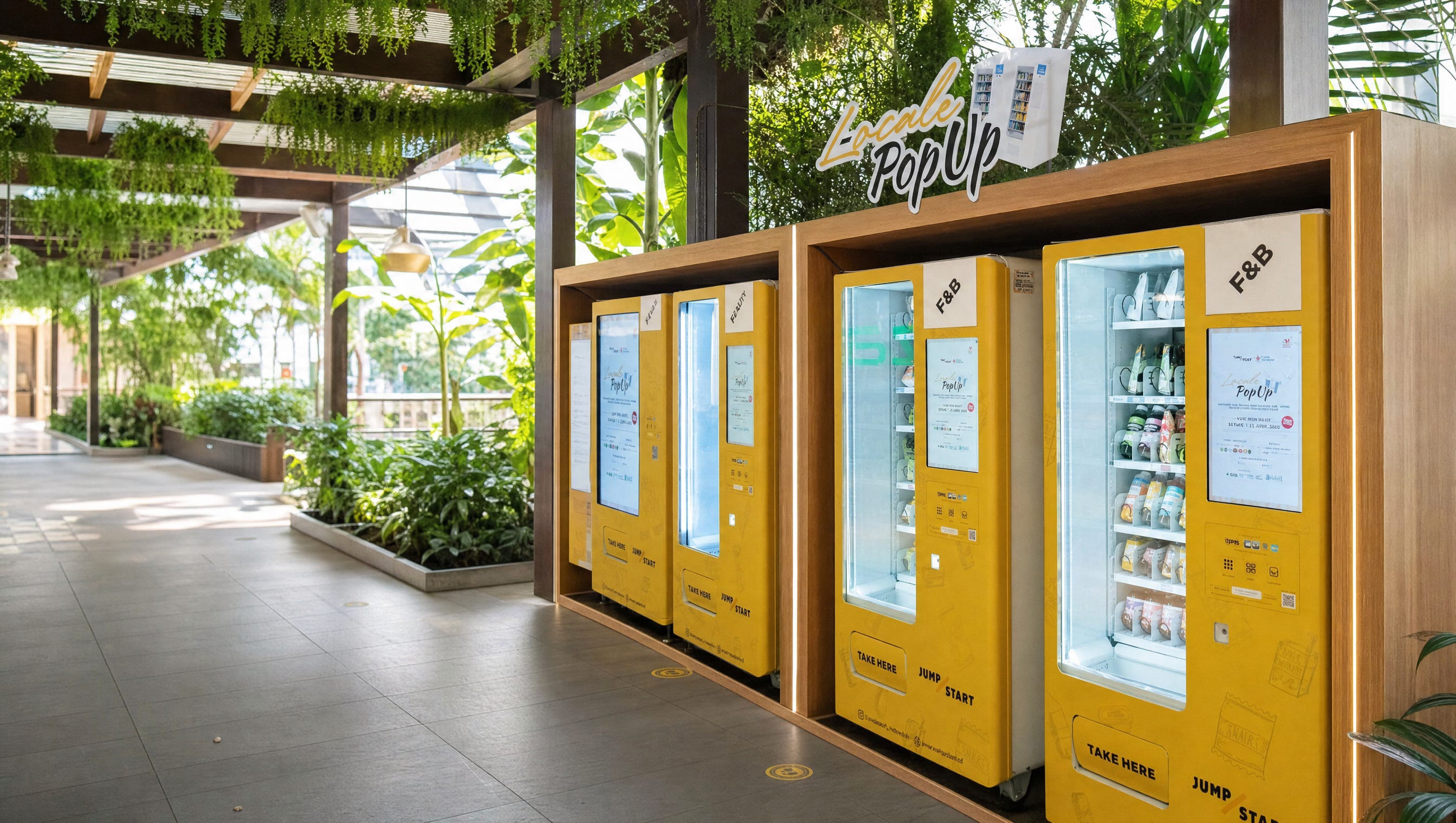
Indonesia is not a market where consumers lack access to everyday products. In many places, there is already a warung, minimarket, supermarket, coffee shop, or delivery app nearby.
So vending machines need a clear role. They probably do not replace existing retail, but they may create a new layer between physical retail, convenience, brand activation, and impulse consumption.
A. How do you see vending machines fitting into Indonesia’s existing retail landscape?
Are they competing with warung, minimarkets, supermarkets, and coffee shops? Or are they serving a different use case altogether?
I do not think vending machines are competing with warungs, minimarkets, supermarkets, or coffee shops. Indonesia’s retail ecosystem is too diverse and too strong for it to be a winner-takes-all game.
We see automated retail as filling gaps that traditional formats cannot always serve efficiently.
A warung has relationships and neighborhood convenience
Minimarkets have accessibility and assortment
Supermarkets serve planned purchases
Coffee shops provide ambience and human interaction.
Vending machines serve a different use case: Speed, proximity, and availability.
They are there for the commuter rushing to catch a train, the office worker needing coffee between meetings, the hospital visitor late at night, or the apartment resident who wants something quick without leaving the building.
These are moments where opening a full store may not be practical, but demand still exists. That is why we do not see ourselves as disrupting traditional retail.
We see ourselves as complementing it. Consumers do not think in channels. They choose the most convenient option in that moment.
Retail is not about replacing existing channels. It is about being present wherever and whenever consumers need you.
B. What is the specific job vending machines can do better than traditional retail channels?
Is it 24/7 access, faster checkout, smaller footprint, lower labor dependency, or something else?
If I had to pick one, vending machines deliver convenience exactly at the point of demand. Traditional retail works well when consumers are willing to go to the store. Automated retail is most powerful when the store needs to come to the consumer.
So the better question is not, “Can vending replace a minimarket?”
The better question is: Are there moments of demand that existing channels cannot serve efficiently?
A commuter with two minutes before the train departs needs coffee immediately. A hospital visitor at midnight needs access. An office employee between meetings wants speed.
Those micro-moments happen every day. Many are too fragmented, urgent, or operationally inefficient for traditional retail to capture.
That is where automated retail wins. Bring retail closer to consumers by removing friction: the right product, in the right place, at the right moment.
C. What types of locations have shown the strongest product-market fit for JumpStart so far?
If you had to choose your top 5 best-performing location types, what would they be, and why do they work?
One thing we have learned is that the best locations are not always the ones with the highest foot traffic. They are the ones with the highest frequency of unmet demand.
Our top five location types are:
1. Office Buildings
Recurring routines create recurring demand: morning coffee, afternoon pick-me-ups, quick snacks, and late-night refreshments.
2. Transportation Hubs
MRT stations, airports, and train stations create “I need it now” moments. People are rushing, waiting, or in transit, so they value speed over browsing.
3. Hospitals and Hotels
These locations operate 24/7, but many retail options do not. Visitors, staff, and workers still need access to food and beverages outside normal hours.
4. Residential Apartments and Mixed-Use Developments
People increasingly expect convenience where they live. Automated retail extends everyday access without requiring residents to leave the property.
5. Events and Experiential Activations
Events allow brands to turn vending into experience through customization, limited-edition products, gamification, or interactive campaigns.
What these locations share is clear: Consumers are not looking for a traditional shopping experience. They are looking for speed, access, and convenience at a specific moment of need.
If I had to summarize our location strategy: We do not follow foot traffic. We follow friction.
D. From a brand partner perspective, why should a brand work with JumpStart?
Is the value more about distribution, trial, activation, data, visibility, or being closer to the consumption moment?
I would say it is all of the above: distribution, trial, activation, data, visibility, and access. But if I had to prioritize, it is about being closer to the moment of consumption.
Traditional channels like minimarkets, supermarkets, e-commerce, and delivery platforms are important. We do not replace them.
What JumpStart offers is different: The ability to place a brand exactly where and when consumer intent happens.
For brands, that means incremental distribution rather than redistributed sales.
It means launching in an office tower without opening a store, sampling products in an MRT station during peak hours, activating a campaign at a concert, or reaching consumers in hospitals and residential buildings where traditional retail presence may be limited.
JumpStart also provides data and agility. Brands can test products, optimize assortments by location, measure conversion, run promotions, and adapt faster.
So if supermarkets are built for scale and e-commerce is built for search, JumpStart is built for context. The better question for brands is: What consumer moments are we missing today?
E. What are the top 3 product categories that work best in JumpStart VM today, and what are the bottom 3 categories that are still difficult to sell?
One of the biggest misconceptions about vending is: “If it sells in a store, it will sell in a machine.” We have learned that is not true. Success depends on the purchase occasion.
The top three categories are:
1. Coffee and ready-to-drink beverages. Consumption is immediate and habitual. People buy when they need energy, are commuting, or are between meetings.
2. Snacks and impulse food items. The decision cycle is short: consumers see it, want it, and buy it.
3. Limited-edition products and brand activations. Event merchandise, collectibles, beauty samples, or collaborations can create urgency because consumers know they can only get them there and then.
The more challenging categories are:
1. High-value products. Consumers want reassurance, comparison, and a chance to evaluate before purchasing.
2. Complex or educational products. Products that require explanation or consultation do not naturally fit an unattended format.
3. Planned-purchase categories. Large grocery baskets or planned purchases are usually better suited for supermarkets, minimarkets, or e-commerce.
F. How do you think about SKU curation?
Because vending machines have limited space, every SKU needs to earn its place. So what makes a product suitable for automated retail?
SKU curation is one of the most important capabilities in automated retail. Unlike a supermarket with thousands of products, every slot in a vending machine is valuable real estate.
Every SKU has to justify why it deserves to be there.
For us, we look at five things:
Velocity. Does it sell consistently and fast enough?
Impulse potential. Can consumers decide within seconds?
Occasion fit. Does it match the location and consumption moment?
Operational suitability. Can it be stocked, stored, and dispensed reliably?
Margin and economics. Does it make sense for the brand and platform?
The biggest mindset shift is that we do not try to replicate a minimarket assortment. In automated retail, consumers often already know the problem they are trying to solve: coffee before a meeting, a quick snack, or something they forgot before boarding.
It is not about offering more choices.
It is about offering the right choices.
5. The Future of Vending Machines & Automated Retail in Indonesia
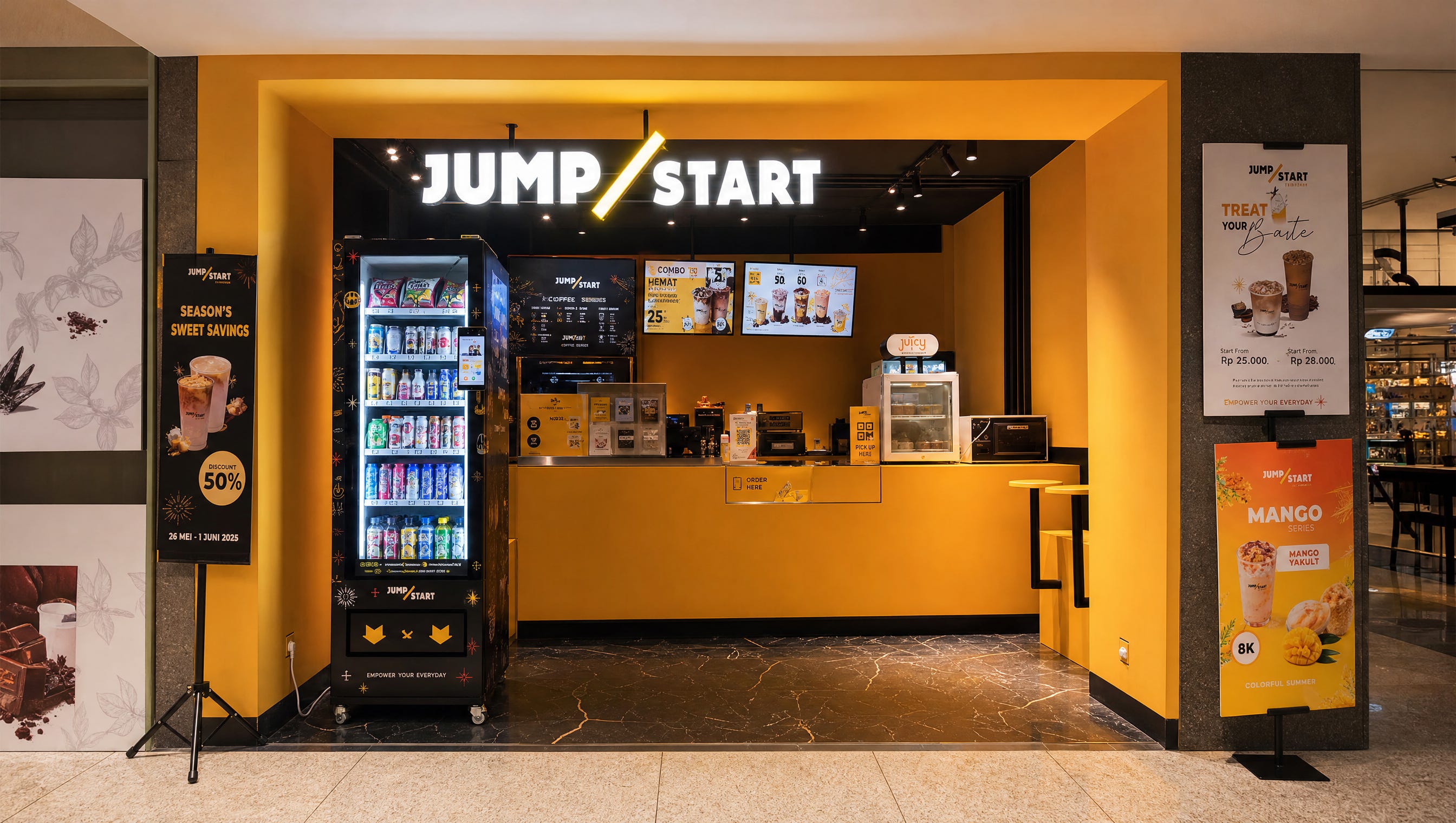
In some countries, vending machines are already part of daily life. But in Indonesia, the habit is still developing.
The future of vending machines here depends not only on the machine. It depends on habit formation, trust, payment infrastructure, location density, product relevance, and whether the experience is consistently easy.
A. How do you see the vending machine market in Indonesia today?
Are we still in the education phase, or are we already entering a more serious adoption phase?
Today, I believe Indonesia is moving into the adoption phase. The reason is simple: the market fundamentals have caught up.
Consumers are already comfortable with QRIS, e-wallets, self-checkout, and on-demand services.
Brands are looking for more efficient ways to expand distribution without the high capital expenditure of opening stores.
Property owners want to activate their spaces with solutions that generate revenue while improving tenant experience.
As one of the largest smart retail platforms in Indonesia, we have seen this evolution happen in real time across categories, locations, and partners.
We see consumers returning to machines as part of their routines.
We see brands treating automated retail as a recurring channel rather than a one-off activation.
We see property partners integrating smart retail into long-term planning.
Those are signs of a market moving beyond experimentation. That said, Indonesia is still early compared to more mature markets.
So if I had to summarize where we are today: The consumer education phase is largely behind us. The real race now is execution.
The winners will not simply be the companies with the most machines. They will be the ones that can build the strongest ecosystem: the right locations, operational excellence, technology, innovation, data, and brand partnerships.
B. What has changed in Indonesia over the last few years that makes automated retail more possible now?
Is it e-wallet adoption, consumer comfort with self-service, better hardware, better IoT, or others?
Indonesia has finally reached the right moment for automated retail. A few years ago, we had to educate consumers on how to use vending machines and why they mattered.
Today, people are already comfortable with QRIS, e-wallets, ordering through apps, and using self-service technologies. COVID also accelerated contactless experiences.
At the same time, the technology behind automated retail, IoT, remote monitoring, and smarter operations has become much more reliable.
Brands and property owners are also looking for more efficient ways to grow.
In other words: Vending machines did not suddenly become smarter. Indonesia changed.
C. In the next 3 to 5 years, what do you think vending machines in Indonesia will become?
In the next 3 to 5 years, I think they will become a mainstream retail channel.
We will see them evolve from selling snacks and drinks to enabling wider use cases: fresh coffee, beauty products, merchandise, essentials, and brand activations.
Machines will become smarter, more personalized, and more integrated with digital ecosystems through loyalty programs, data, and targeted promotions.
More importantly, brands will stop seeing automated retail as an experiment or marketing gimmick. They will view it as a strategic channel alongside minimarkets, e-commerce, and delivery platforms.
Consumers will not think, “I am buying from a vending machine.”
They will simply think: “This is the fastest and most convenient way to get what I need right now.”
The future of vending is not about machines. It is about making retail more accessible, more efficient, and available wherever demand exists.
D. How do you see AI, data, and consumer insights changing this business?
AI, data, and consumer insights will change this industry because automated retail generates something traditional offline retail often struggles to capture: Real-time behavioral data.
In the past, retail was largely reactive. You looked at what sold last month and adjusted from there. In the future, AI will help us become more predictive.
It can recommend the right SKU mix for each location, forecast demand, optimize replenishment routes, personalize promotions, and even predict when a machine needs maintenance before it breaks down.
Consumer insights will also become more granular. We will understand not just what people buy, but where, when, and in what context they buy it.
A machine in an office may have very different consumption patterns from one in an MRT station or hospital. AI can help us adapt in real time.
E. Can vending machines eventually scale beyond Tier 1 cities in Indonesia?
If yes, what needs to be true for that to happen?
Absolutely. I think the real long-term opportunity lies beyond Tier 1 cities. But expansion will not happen by placing machines everywhere.
A common misconception is that automated retail only works in Jakarta, Surabaya, or Bali because consumers there are more familiar with technology.
What we have learned is that adoption is less about city tier and more about whether the right conditions exist.
Three things need to be true.
1. There has to be sufficient demand concentration: universities, hospitals, transportation hubs, office clusters, residential developments, or tourist destinations where people naturally gather and convenience matters.
2. The digital infrastructure needs to be there. QRIS adoption and smartphone penetration have expanded rapidly across Indonesia, making cashless transactions more accessible outside major cities.
3. Most importantly, the economics and operations must work.
Automated retail is ultimately an execution business. You need reliable replenishment, service teams, and local partnerships to maintain a consistent consumer experience.
A machine that is empty or out of service quickly loses trust.
So yes, vending machines can scale beyond Tier 1 cities. But the winning strategy will not be a blanket rollout. It will be targeted expansion into locations where automated retail solves a real consumer need and where we can support it operationally.
6. Operating Model: The Hard Part Behind VM
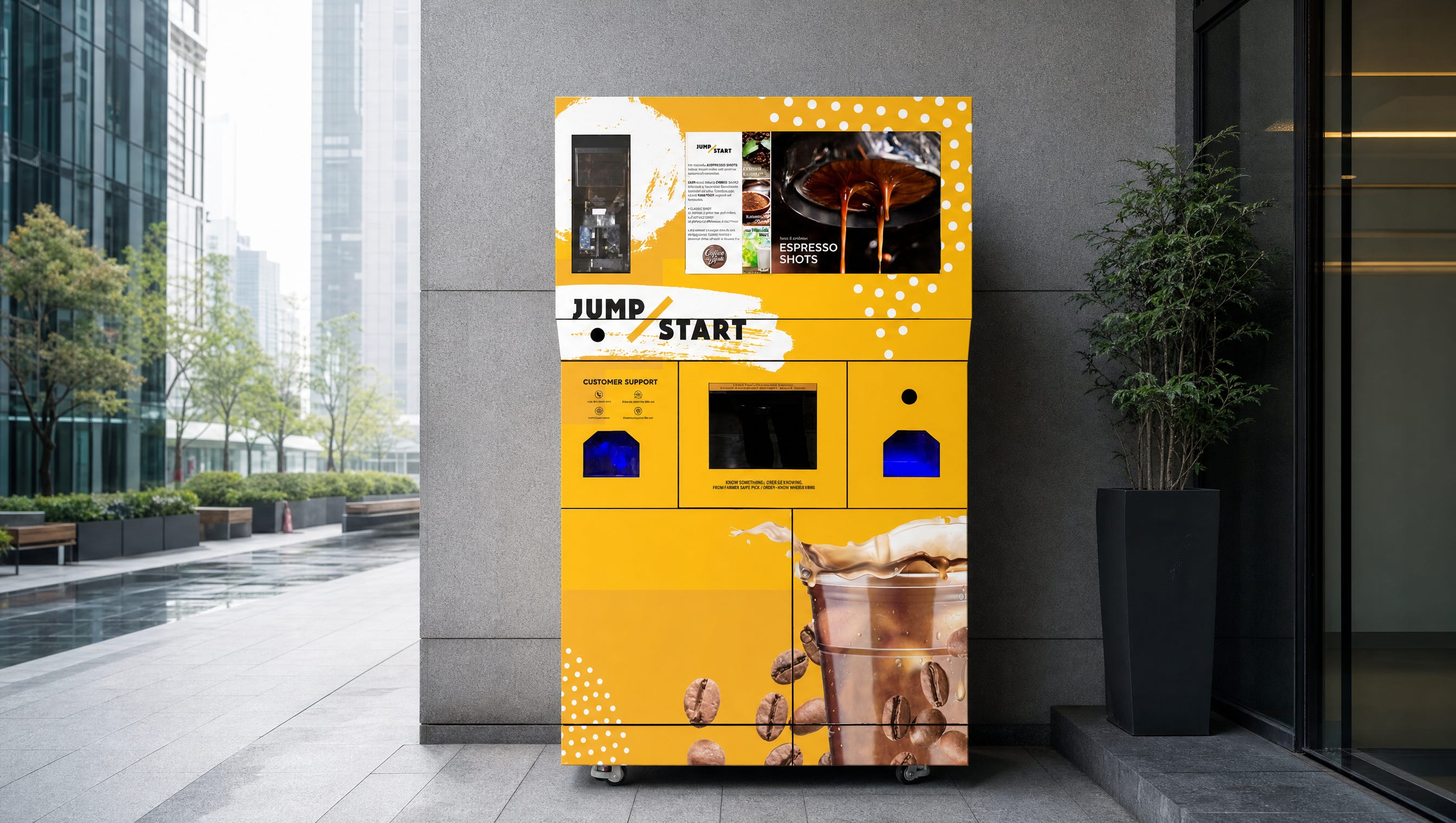
From the outside, vending machines can look asset-light and simple. Install the machine. Fill the product. Collect payment. Repeat.
But the real business is much more operationally intense: hardware, software, payment, replenishment, maintenance, location management, SKU planning, customer service, brand partnerships, demand forecasting, and machine-level profitability.
In many ways, vending machines are a combination of retail, logistics, hardware, software, and operations.
A. What are the biggest operational challenges in running thousands of vending machines across Indonesia?
People often think the hardest part of this business is buying the machines.
In reality, that is the easy part. The real challenge begins once you have thousands of machines operating every day across a country as complex as Indonesia.
1. Operations and replenishment. Having the right products in the right machine at the right time sounds simple, but managing inventory across hundreds of locations requires precision. An out-of-stock machine is a lost sale and a disappointed customer.
2. Service and maintenance. In automated retail, the machine is the store, the cashier, and sometimes even the barista. If payment fails, coffee quality drops, or a machine goes offline, there is no staff on-site to recover the experience immediately.
3. Third is Indonesia itself. We are an archipelago with diverse geographies, traffic conditions, and infrastructure challenges. Scaling operations in Jakarta is very different from scaling across multiple islands and cities.
And finally, it is about maintaining consistency at scale.
Consumers do not lower their expectations just because it is a vending machine. Whether it is machine number 10 or machine number 1,000, they expect the same product quality, payment experience, and service level.
That is why I often say this is not a machine business.
It is an execution business.
The companies that succeed will not necessarily be the ones with the most machines. They will be the ones that can operate thousands of machines with the discipline, reliability, and consistency of a great retailer.
B. Which part of the vending machine business is usually underestimated by people from the outside?
Machine maintenance, refill operations, demand forecasting, location selection, or others?
All of them matter, but the most underestimated parts are demand forecasting and operations. People see the machine. They do not always see the system required to keep the machine useful, available, stocked, and profitable.
C. How do you evaluate whether a location is attractive?
Is it foot traffic, dwell time, consumer profile, rent structure, product category fit, or repeat behavior?
People often assume we only look at foot traffic, but foot traffic alone can be misleading. A location with 50,000 people passing by is not necessarily better than one with 5,000 people if those people are not in a buying mindset.
So if I had to rank them:
Consumer profile and repeat behavior come first
Product-category fit comes second
Foot traffic comes third
D. What are the top 5 machine-level metrics JumpStart tracks most closely?
Why are these non-negotiable for understanding whether a vending machine is working or not?
If I had to choose the five non-negotiable machine-level metrics, they would be:
1. Sales per Machine. Is the machine generating enough sales to justify its existence? This tells us whether the location and assortment are working.
2. Transactions per Day. Revenue alone can be misleading. We want to know how many people are actually using the machine.
3. In-Stock Rate. You cannot sell what is not there. If a machine is frequently out of stock, we lose sales and damage trust. High availability is non-negotiable.
4. Machine Uptime. A machine that is offline is essentially a closed store. Payment functionality, connectivity, and uptime are critical.
5. Repeat Purchase Rate. First-time purchases can happen because of curiosity. Repeat purchases happen because we have delivered value.
Together, these metrics tell a story: high traffic but low transactions may suggest product or pricing issues; strong demand but low availability points to replenishment; one-time spikes without repeat purchase may indicate weak long-term fit.
E. How do you balance growth with operational quality?
Because the more machines you deploy, the harder it becomes to keep service levels, product availability, and customer experience consistent.
This is one of the hardest challenges in our business, because growth in automated retail is deceptively easy. Anyone can buy more machines and put them in more locations.
The real question is: Can you maintain the same quality when you go from 100 machines to 1,000, and eventually to 10,000?
Our philosophy is that we would rather scale right than scale fast. We do not measure success only by the number of machines deployed. We measure it by whether consumers receive the same experience every single time.
A machine that is out of stock, offline, or serving inconsistent products does not just hurt that location. It hurts trust in the entire brand.
That is why we invest in the less glamorous parts of the business: strong SOPs, real-time monitoring, demand forecasting, preventive maintenance, and local operations teams.
We also stay disciplined about expansion. We do not enter a new city or add hundreds of machines unless we are confident we can support them operationally. Growth without execution creates complexity faster than capability. I often tell the team that our biggest competitor is not another vending company. It is inconsistency.
Consumers do not care how many machines we operate. They remember whether the coffee tasted good, whether the payment worked, and whether the product they wanted was available.
So every machine we add should strengthen the network, not dilute the experience.
F. What has JumpStart learned about Indonesian consumers from transaction data that surprised you?
One of the biggest surprises is that Indonesian consumers adapt much faster than we expected.
We initially thought vending machines would remain a novelty and that people would be very price-sensitive. Instead, we found that if the experience is reliable, good product quality, easy payment, and consistent availability, people quickly turn it into a habit.
We also learned that convenience often matters more than price, and that location and context are more important than demographics.
The biggest insight was this: Consumers do not use vending machines because they are new or trendy.
They use them because they solve a real problem and make everyday life a little easier.
7. Funding, Future, and the Next JumpStart
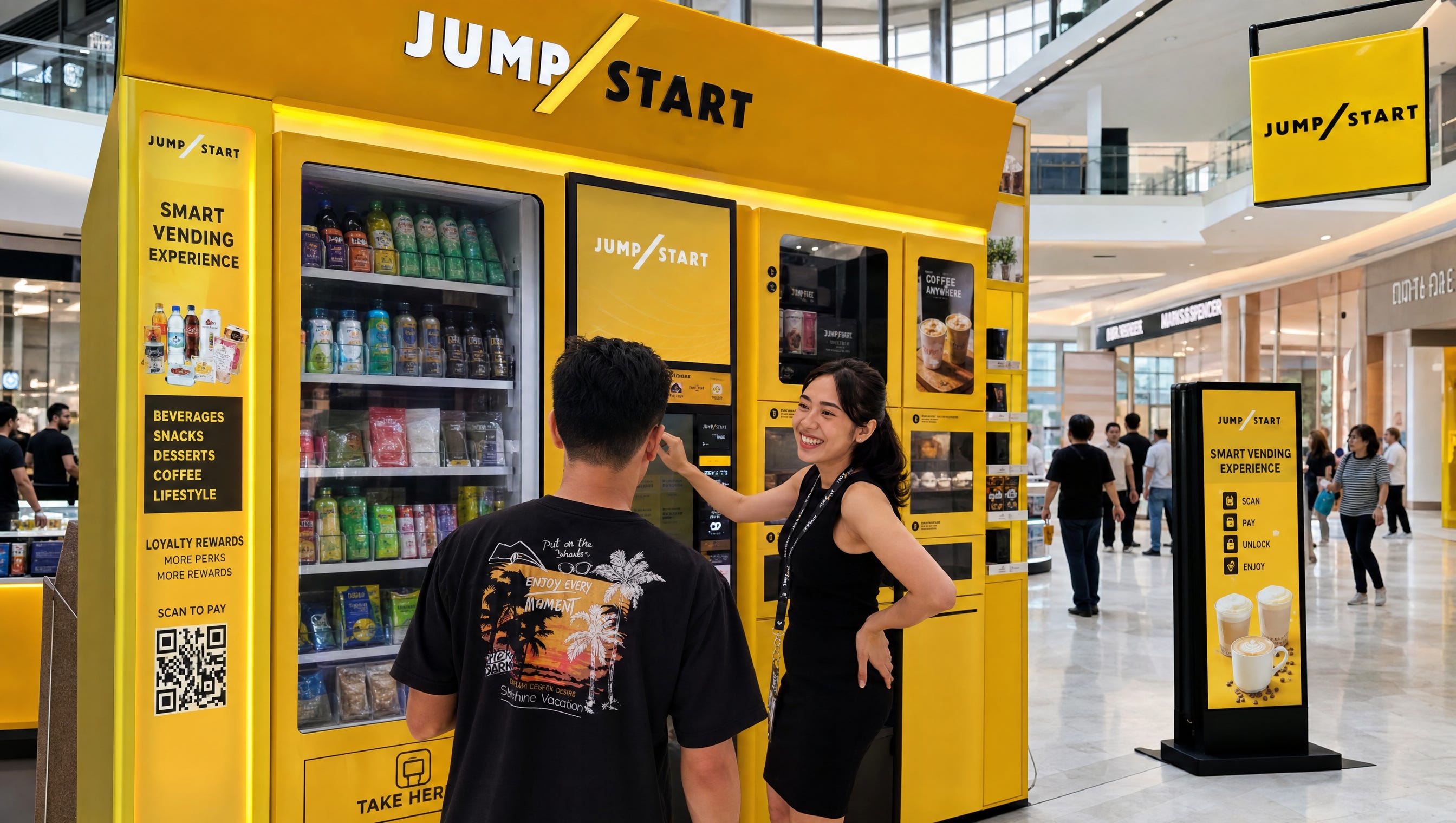
JumpStart recently raised its latest funding round, and the next question is whether the company can become a scalable automated retail platform.
That means more machines, but also better locations, stronger infrastructure, sharper assortment, deeper partnerships, and smarter use of data.
A. With the latest funding round, what are the most important things JumpStart wants to build or strengthen?
Our focus is not just deploying more machines or expanding to more locations. It is about strengthening the foundation to scale sustainably.
B. How are you planning to use the new funding?
First, we are investing in technology and data capabilities: better forecasting, real-time insights, AI-driven decision-making, and a more seamless consumer experience.
Second, we are strengthening operations and supply chain. As we grow, machine uptime, product availability, and service quality become even more critical.
Third, we are expanding brand and location partnerships, so more brands can use automated retail for distribution, activation, and consumer engagement.
C. What makes Cool Japan Fund a strategic investor?
Especially given JumpStart’s role as a possible distribution channel for global brands and Japanese food, beverage, and lifestyle products in Indonesia.
Cool Japan Fund is more than just an investor for JumpStart. It is a strategic partner.
Japan is one of the most advanced automated retail markets in the world, and Cool Japan Fund brings experience, networks, and access to Japanese and global brands looking to grow in Indonesia.
At the same time, JumpStart provides what those brands need: local market knowledge, operational capabilities, and a scalable distribution platform.
Together, we can help brands test products, build awareness, and reach Indonesian consumers through smart retail without immediately investing in physical stores.
In many ways, this reinforces our vision of JumpStart not just as a vending machine company, but as a bridge connecting global brands with Indonesian consumers through modern retail.
D. Looking 3 to 5 years ahead, what does the next JumpStart look like?
Three to five years from now, I see JumpStart evolving from Indonesia’s largest smart retail platform into the default automated retail partner for brands in Indonesia, with new innovation and product offerings.
E. How do you think about expansion beyond Indonesia?
Is Southeast Asia part of the plan, or is the priority still to deepen Indonesia first?
Southeast Asia is definitely an exciting opportunity.
But our priority today is still Indonesia.
Indonesia alone is a massive market, and there is still a lot of room to deepen our network, strengthen operations, and build stronger habits here first.
F. What would success look like in the next few years?
Is it machine count, revenue scale, profitability, brand partnerships, consumer habit formation, location density, becoming a default automated retail channel for brands, or others?
Machine count, revenue scale, brand partnerships, and location density matter.
But the bigger goal is this: JumpStart becomes the trusted infrastructure behind automated retail in Indonesia.
A platform where brands grow, consumers build habits, and smart retail becomes a normal part of everyday life.
Closing
Really appreciate the time and openness from Raynald Rabindra Soeharto, CMO at JumpStart. This conversation gives a deeper look into a category that is still early, but potentially important for the future of retail in Indonesia.
At first glance, JumpStart may look like a vending machine company.
But the more interesting question sits behind the machine: Can automated retail become a new distribution layer in Indonesia?
In Indonesia, distribution is already strong. The opportunity is not simply about putting products closer to consumers.
It is about putting the right products in the right locations, at the right moments, with the right level of convenience, trust, and operational consistency.
If vending machines can move from novelty to habit, from machine network to retail infrastructure, and from product access to data-driven distribution, then the category could become much bigger than people expect.
Find out more about JumpStart:
Website: https://jumpstartindonesia.com/
Instagram: https://www.instagram.com/jumpstart_indonesia/
Before You Go
If you enjoy pieces like this, subscribe to Our Substack by cliking the link below
And follow us on Instagram @neverlaterventures
And as always, if there’s someone you think we should speak to next, let us know.